
Your cart
There are no more items in your cart
- Supplement Education
- 1 likes
- 15026 views
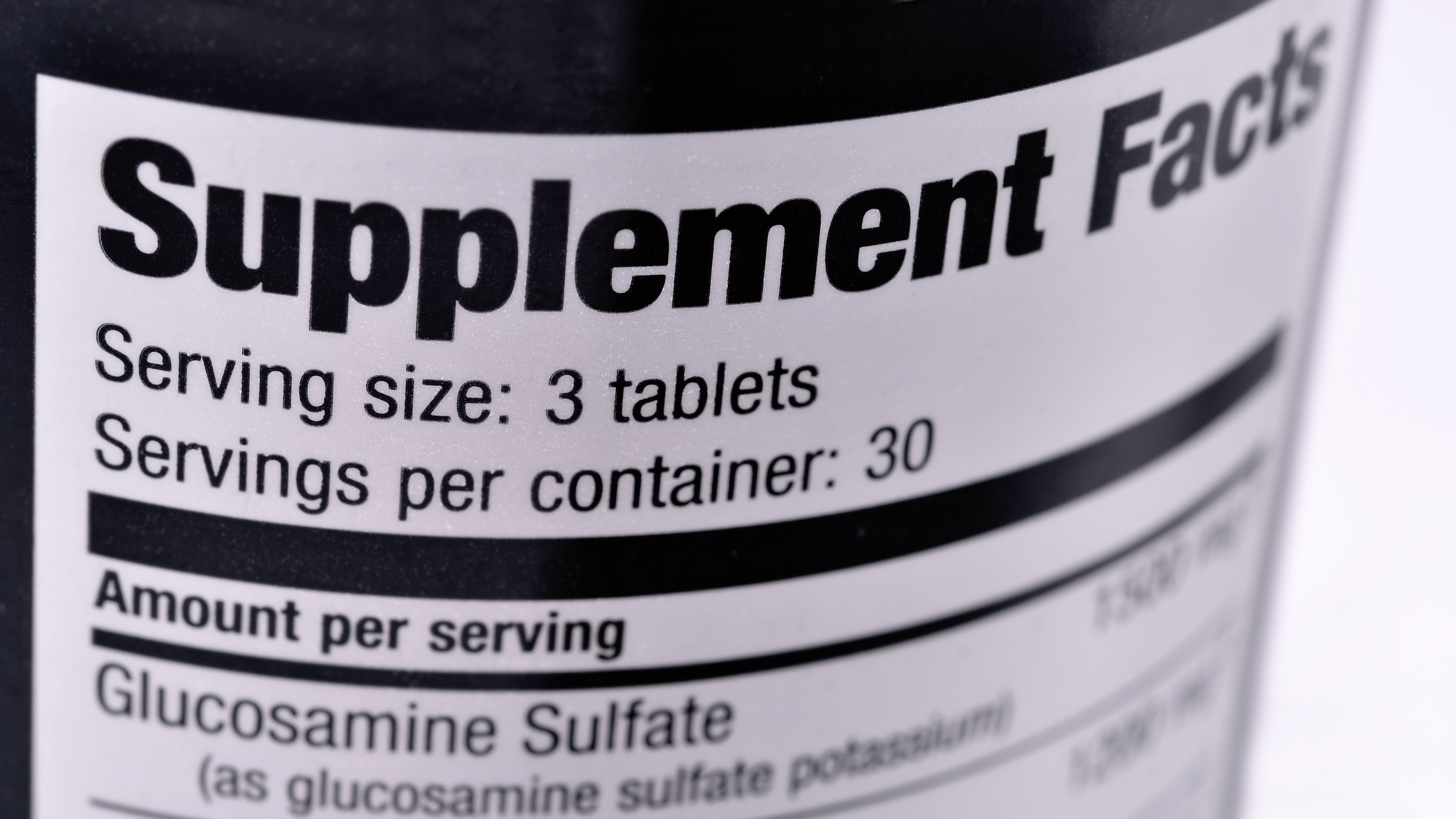
A supplement label contains far more than a product name and dosage. It can tell you what the product contains, how much you are actually taking, how transparent the formulation is, how it should be stored, when it was manufactured and how the batch can be traced.
For many people, supplement labels can feel confusing at first. Serving sizes, active ingredients, other ingredients, NRV percentages, manufacturing dates, expiry dates, batch numbers and certifications all appear in a small space, often using abbreviations that are not immediately clear.
To make things even more confusing, not every important detail appears on the main front or back label. Some information may be printed on the bottom of the bottle, on the lid, on the neck of the container, on the outer box, on a side sticker or near the barcode. This is especially common for details such as LOT, MFG, DOM, EXP and storage instructions.
Yet learning how to read a supplement label is one of the most useful skills you can develop as a consumer. It helps you compare products more accurately, avoid common misunderstandings and make more informed choices based on facts rather than marketing claims.
At Vita-Store, we believe that understanding should always come before choosing. This guide explains the most important parts of a supplement label in clear, practical language so you can feel more confident before buying or using a dietary supplement.
Vita-Store Checklist
- ✓ Read the full label, not only the front of the bottle.
- ✓ Check the serving size before comparing nutrient amounts.
- ✓ Look for the exact form of active ingredients.
- ✓ Review the “Other Ingredients” section.
- ✓ Check LOT, MFG, DOM or EXP information — sometimes printed on the bottom, lid or outer box.
- ✓ Follow the storage instructions for the specific product.
- ✓ Compare products by transparency and formulation, not just by price or dosage.
Why supplement labels matter
When choosing a dietary supplement, it is easy to focus on the front of the bottle. Product names, large numbers, bold claims and attractive packaging are designed to catch attention. However, the front label rarely tells the full story.
The most useful information is usually found on the back or side of the packaging. This is where you can often find the serving size, the active ingredients, the amount per serving, the other ingredients, warnings, storage instructions, manufacturer information and suggested use.
However, some important details may appear elsewhere. Batch numbers and date codes are frequently printed on the bottom of the bottle, on the cap, on the outer carton or as a small inkjet code near the label seam. If you cannot find a LOT or expiry date immediately, it is worth checking the entire package carefully.
Reading these details helps you understand what you are actually buying. Two supplements may look similar at first glance, but their formulas, dosage, ingredient quality, transparency and storage requirements can be very different.
A good label should help you answer practical questions, such as:
- How many capsules, tablets or scoops make up one serving?
- How much of the active nutrient is provided per serving?
- Are the ingredient forms clearly listed?
- Are there unnecessary fillers or additives?
- Does the product contain allergens?
- How should the product be stored?
- When was it manufactured and when does it expire?
- Can the product be traced by batch or lot number?
Once you know how to interpret these details, supplement labels become much less intimidating and much more useful.
Quick Fact
The front of a supplement bottle is often designed for marketing. The back label, side label, bottom of the bottle, lid or outer box may contain the details you need to compare products properly.
The anatomy of a supplement label
Although supplement packaging differs between brands and countries, most products include several common sections. Understanding these sections makes it easier to know where to look for specific information.
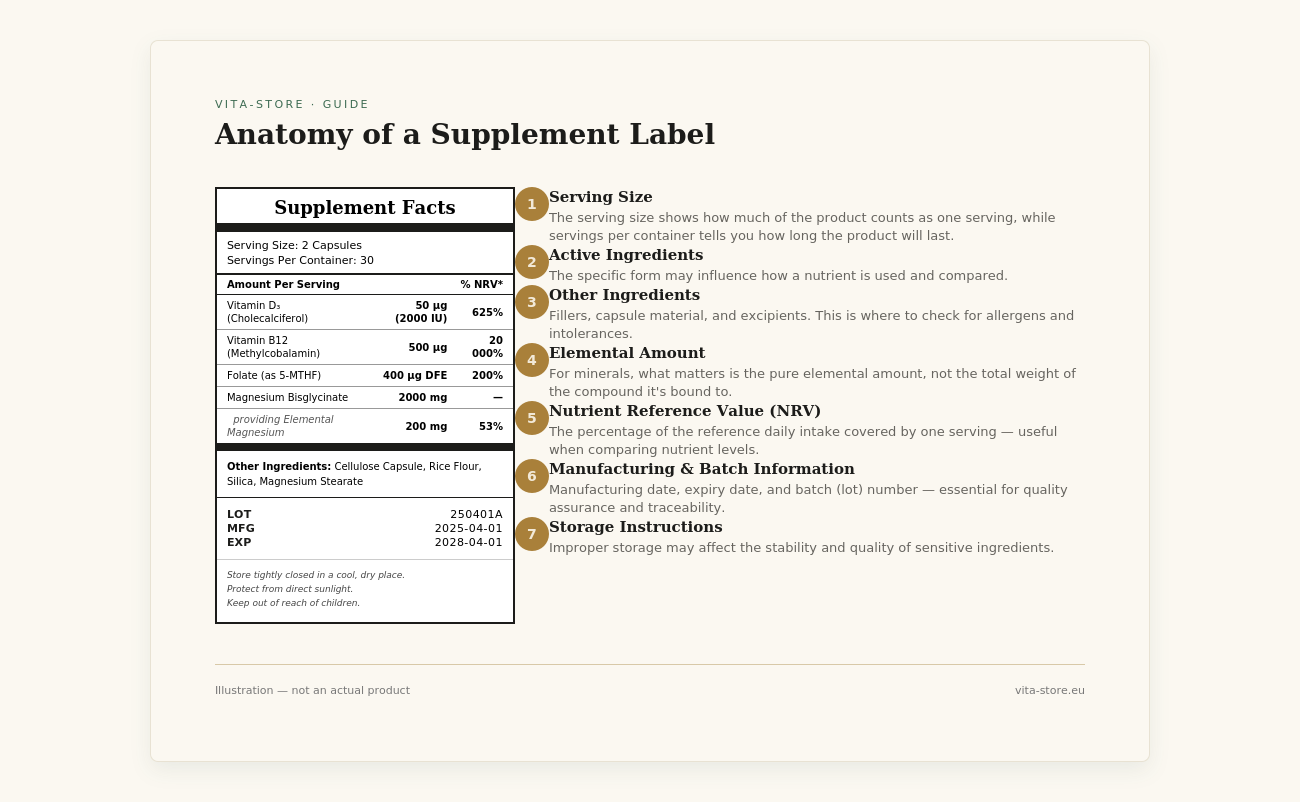
The infographic below shows the main parts of a typical supplement label and explains what each section means.
Serving Size: one of the most common sources of confusion
The Serving Size tells you how much of the product the manufacturer defines as one serving. This is not always the same as one capsule, one tablet or one scoop.
For example, a label may say:
Serving Size: 2 capsules
Vitamin D: 50 µg
In this case, the 50 µg of vitamin D refers to two capsules, not one. If you take only one capsule, you are taking half of the listed amount.
This is one of the most common mistakes people make when reading supplement labels. They see the nutrient amount and assume it applies to a single capsule or tablet, even when the serving size is higher.
Always check the serving size before comparing products. A supplement that appears stronger may simply have a larger serving size.
Servings Per Container: how long will the bottle actually last?
Servings Per Container tells you how many full servings are included in the package. This is especially useful when comparing price and value.
For example:
Capsules in bottle: 60
Serving Size: 2 capsules
Servings Per Container: 30
This means the bottle lasts 30 days if you take one full serving per day. Another bottle may also contain 60 capsules, but if the serving size is 1 capsule, it provides 60 servings.
For this reason, the cheapest bottle is not always the best value. To compare products properly, look at the cost per serving, not only the total price or capsule count.
Vita-Store Tip
When comparing two supplements, calculate how many full servings each bottle provides. Capsule count alone can be misleading.
Daily Dose vs Serving Size
Serving size and daily dose are closely related, but they are not always the same thing.
The serving size is the amount used to calculate the values on the label. The daily dose is how much the manufacturer recommends taking per day. In many cases they are identical, but not always.
Some products may suggest taking one serving daily. Others may recommend one serving once or twice per day, or a different dose depending on age, need or professional guidance.
This is why it is important to read the Directions for Use section as well as the Supplement Facts panel.
If you are taking several supplements at the same time, it is also worth checking whether they contain overlapping nutrients. For example, a multivitamin, a mineral complex and a sleep formula may all contain magnesium, vitamin B6 or zinc.
Quick Fact
Serving Size shows how the label values are calculated. Directions for Use tell you how the manufacturer recommends taking the product.
Understanding each section of a supplement label
Now that you've seen the anatomy of a typical supplement label, let's take a closer look at what each section actually tells you. While labels vary slightly between manufacturers and countries, most follow the same basic structure.
Learning to recognise these sections makes it much easier to compare products objectively and understand exactly what you're buying.
Serving Size and Servings Per Container
The first section to check is the Serving Size. This tells you how much of the product the nutrition information refers to. Depending on the supplement, one serving may be one capsule, two capsules, one scoop or a measured amount of liquid.
Just below it, you'll usually find Servings Per Container, which indicates how many servings the package contains. Together, these two pieces of information help you estimate how long the product will last when used according to the suggested serving.
Quick Fact
Many people compare nutrient amounts without first checking the serving size. Always make sure you're comparing equivalent servings.
Active Ingredients
The Active Ingredients section lists the nutrients or compounds that provide the intended nutritional or physiological function of the supplement.
Besides the amount, it's worth paying attention to the specific form of each ingredient. For example, labels may specify Vitamin B12 as methylcobalamin, folate as 5-MTHF or magnesium as magnesium bisglycinate.
Different forms are listed separately so consumers can clearly identify the formulation used by the manufacturer.
Scientific Note
Many vitamins and minerals exist in several chemical forms. Transparent labels identify the exact form rather than simply listing the nutrient name.
Other Ingredients
Most supplements also contain ingredients that are not considered active nutrients. These are listed separately as Other Ingredients.
They may include capsule materials, fillers, anti-caking agents or stabilisers that help manufacture and protect the finished product.
If you have allergies, dietary preferences or ingredient sensitivities, this is one of the first sections you should check.
Vita-Store Tip
A transparent ingredient list should clearly distinguish active ingredients from excipients and other non-active components.
Elemental Amount
Mineral supplements often display two different values: the weight of the compound and the amount of elemental mineral it provides.
For example, a label may state 2,000 mg of magnesium bisglycinate while providing 200 mg of elemental magnesium.
When comparing mineral supplements, the elemental amount is generally the figure that should be compared.
Scientific Note
The weight of a mineral compound and the amount of elemental mineral it provides are two different values. This is completely normal and reflects the chemistry of the ingredient.
Nutrient Reference Value (NRV)
The NRV, or Nutrient Reference Value, indicates how much one serving contributes to the European daily reference intake for a healthy adult.
Some nutrients naturally exceed 100% NRV, while others may provide a much smaller percentage. The NRV is intended as a reference for comparison rather than a measure of product quality.
Quick Fact
A higher NRV does not automatically mean a supplement is better. The overall formulation is always more important than a single percentage.
Proprietary blends
Some supplements contain a Proprietary Blend or Proprietary Formula, where the total amount of the blend is disclosed but the exact amount of each ingredient is not.
Although this practice is permitted in some markets, labels that clearly state the quantity of every active ingredient generally make it easier to compare products.
Vita-Store Tip
The more transparent a label is about ingredient amounts and forms, the easier it becomes to compare products and make informed choices.
Where can you find product information?
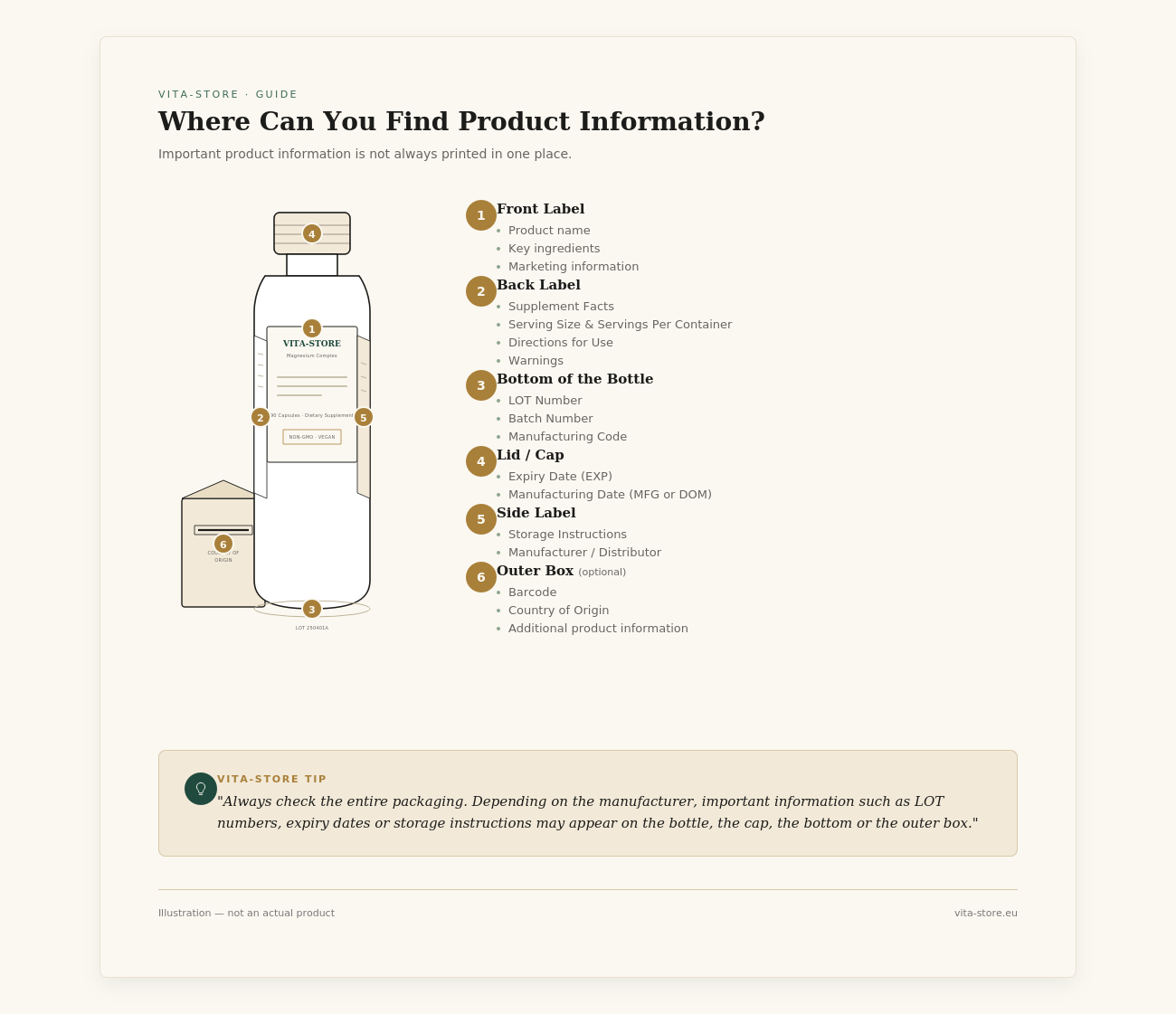
Not all important product information is printed on the front label. Depending on the manufacturer, different details may appear on the back label, the side of the bottle, the bottom, the cap or even the outer packaging.
This is completely normal and often depends on the packaging design, manufacturing process or available space. Learning where to look can save time and help you verify important product information more quickly.
Vita-Store Tip
If you cannot find a batch number or expiry date immediately, don't assume it is missing. Check the cap, the bottom of the bottle and the outer box first.
Manufacturing Date (MFG or DOM)
Many supplement labels include either MFG (Manufacturing Date) or DOM (Date of Manufacture). Although the abbreviations differ, they usually refer to exactly the same information: the date the product was manufactured.
It is perfectly normal for a supplement to have been manufactured several months before you purchase it. Most dietary supplements have a shelf life of two to five years when stored according to the manufacturer's recommendations.
Scientific Note
The manufacturing date helps manufacturers maintain traceability and quality control. It should not be interpreted as an indication that a product is "old".
Expiry Date (EXP, Best Before or BBE)
The expiry date indicates the period during which the manufacturer guarantees the product's quality when stored under the recommended conditions.
You may see different wording depending on the product or country:
- EXP – Expiry Date
- Best Before
- Best Before End (BBE)
These dates should always be considered together with the recommended storage instructions.
Quick Fact
An expiry date is not the moment a supplement suddenly becomes ineffective. It represents the period during which the manufacturer guarantees its quality under appropriate storage conditions.
LOT Number and Batch Information
Every production run receives a unique LOT or Batch Number. This code allows the manufacturer to identify exactly when and where a product was produced.
Batch numbers are used for quality assurance, laboratory records, traceability and customer support. If a manufacturer ever needs to investigate a quality issue or perform a product recall, the LOT number makes it possible to identify the affected production batch.
For consumers, keeping the LOT number can also be helpful if they need to contact the manufacturer with a product-related question.
Vita-Store Tip
If you ever contact a manufacturer about a supplement, include the LOT number whenever possible. It helps identify the exact production batch much faster.
Storage Instructions
Storage recommendations are often overlooked, yet they play an important role in preserving product quality.
Most supplements should be stored in a cool, dry place away from direct sunlight. Some products, particularly certain probiotics or liquid formulations, may require refrigeration after opening.
Following the manufacturer's storage instructions helps maintain the stability of sensitive ingredients throughout the product's intended shelf life.
Scientific Note
Heat, humidity and prolonged exposure to sunlight may reduce the stability of certain vitamins, probiotics and other sensitive ingredients.
Manufacturer and Country of Origin
Many supplement labels also identify the manufacturer, distributor or country of origin. These details improve transparency and help consumers understand where the product comes from.
However, the country of origin alone should not be used to judge quality. Clear ingredient disclosure, good manufacturing practices and transparent labelling are generally more meaningful indicators than a single country name or certification logo.
Vita-Store Checklist
- ✓ Check the entire packaging—not just the front label.
- ✓ Locate the manufacturing date (MFG or DOM).
- ✓ Find the expiry date (EXP or Best Before).
- ✓ Keep the LOT number if you may need customer support.
- ✓ Read the storage instructions before opening the product.
- ✓ Look for transparent manufacturing information.
How to compare supplement labels like an expert
Reading a supplement label isn't about memorising technical terms. It's about knowing which details matter and checking them in a logical order.
Instead of focusing on bold marketing claims, work through the label step by step. This approach makes it much easier to compare products fairly and understand what you're actually buying.
Vita-Store Checklist
- ✓ Check the serving size before comparing nutrient amounts.
- ✓ Read the exact form of each active ingredient.
- ✓ Compare the elemental amount for mineral supplements.
- ✓ Review the Other Ingredients section if you have allergies or dietary preferences.
- ✓ Verify the manufacturing date, expiry date and LOT number.
- ✓ Follow the recommended storage instructions.
- ✓ Compare the complete formulation—not just one number on the front label.
Quick Fact
Two supplements may contain the same amount of a nutrient while differing in serving size, ingredient form, excipients and overall formulation. A complete label comparison provides a much clearer picture than looking at a single number.
Scientific Note
Food supplement labels are regulated differently around the world. While layouts and terminology may vary between countries, the core information—ingredients, serving size, storage instructions and traceability—is generally presented in a similar way.
Final thoughts
The more familiar you become with supplement labels, the easier it is to make informed purchasing decisions. Rather than relying on marketing claims alone, you'll be able to evaluate products based on transparent information and compare them with greater confidence.
At Vita-Store, we believe that understanding a label is one of the most valuable skills any supplement user can develop. A few extra minutes spent reading the packaging can help you better understand what's inside the product—and why that information matters.
Vita-Store Tip
Whenever you try a new supplement, take a moment to read the entire label before opening the package. It's one of the simplest habits that can help you make more informed choices.
This article provides general information and is not a substitute for individual medical advice.