Vitamin D3 and K2 are often sold as an inseparable pair. The explanation sounds convincing: vitamin D increases calcium absorption, while vitamin K activates proteins involved in bone mineralisation and blood clotting. From there, marketing often makes a much bigger leap—that K2 is needed to “send calcium to the bones” and keep it out of the arteries.
The biology is real, but the clinical conclusion is less certain. Vitamin D and vitamin K each have recognised nutritional roles. What has not been established is that everyone taking vitamin D also benefits from adding K2, or that the combination prevents vascular calcification.
Key takeaways
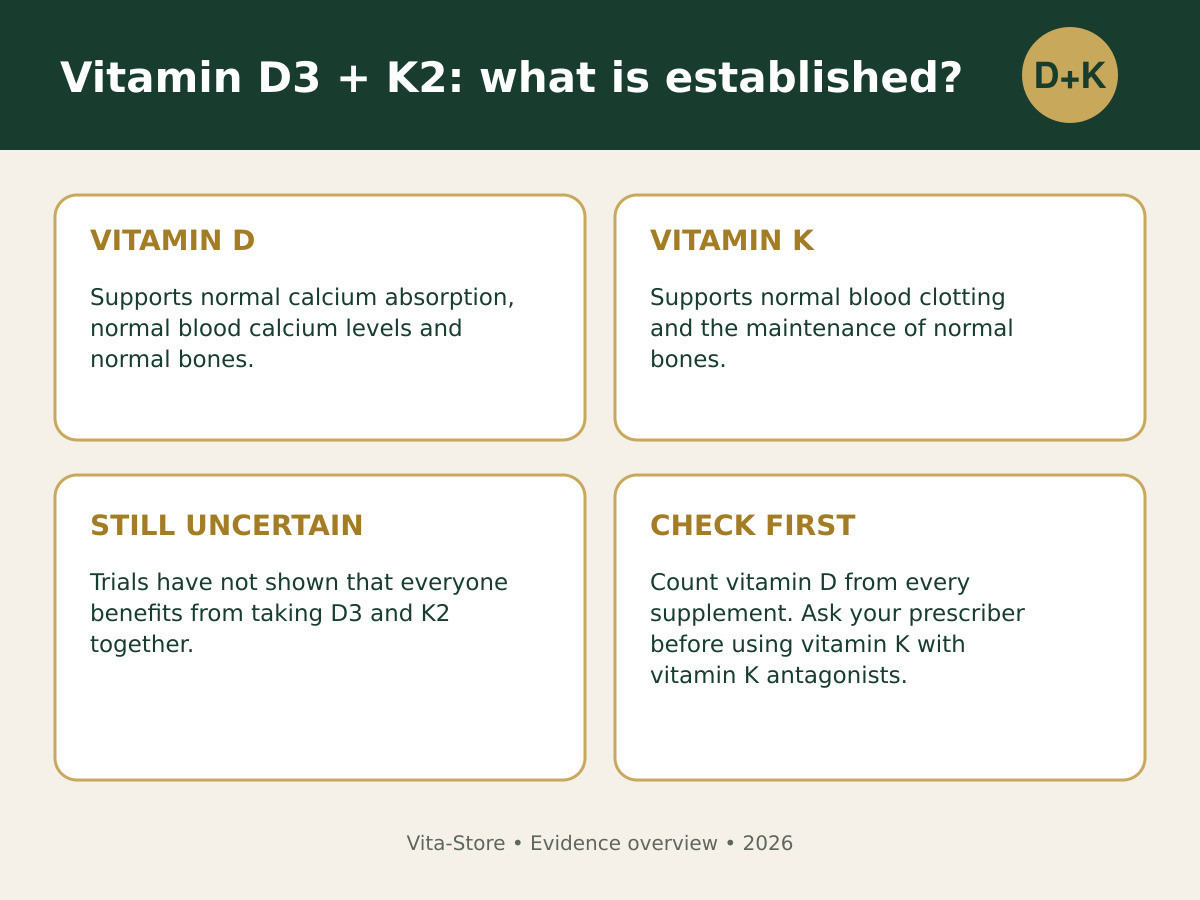
- Vitamin D contributes to normal calcium absorption, normal blood calcium levels and the maintenance of normal bones.
- Vitamin K contributes to normal blood clotting and the maintenance of normal bones.
- These authorised statements apply to the nutrients; they do not prove a special D3–K2 synergy.
- A 2026 analysis found no evidence that baseline vitamin K status enhanced the effects of vitamin D on the measured bone or cardiovascular markers.
- Vitamin K can interfere with vitamin K antagonists such as warfarin. Vitamin D from all supplements should be added together.
This article provides general information and does not replace individual medical advice.
Why are D3 and K2 paired?
Vitamin D helps the intestine absorb calcium and helps maintain normal calcium levels in the blood. Vitamin K is required for the activation of several vitamin-K-dependent proteins, including osteocalcin and matrix Gla protein. This provides a plausible reason to study the nutrients together.
Plausibility, however, is not the same as a proven outcome. The popular phrase that K2 “directs calcium into bone and away from arteries” compresses a complex process into a promise that human trials have not consistently confirmed.
What can legally be said about the benefits?
EU-authorised health claims give a useful boundary. Vitamin D may be described as contributing to normal absorption and utilisation of calcium and phosphorus, normal blood calcium levels, normal bones, normal muscle function, normal teeth and normal immune function. Vitamin K may be described as contributing to normal blood clotting and normal bones.
There is no authorised claim that K2 prevents calcium from entering arteries, reverses calcification, or must always accompany vitamin D. Those ideas can be discussed as research questions, but not presented as established benefits of a supplement.
What do human studies show?
Some trials and reviews report favourable changes in bone-turnover markers or bone mineral density when vitamin K is used alongside vitamin D and sometimes calcium. The studies differ in population, duration, dose and the form of vitamin K, and fracture data remain limited. A change in a laboratory marker is not automatically the same as fewer fractures.
The cardiovascular evidence is weaker. Observational studies can find associations between vitamin K intake or status and vascular outcomes, but they cannot show that a supplement caused the difference. In a two-year randomised trial, K2 plus vitamin D did not significantly reduce average progression of coronary artery calcification compared with placebo.
A 2026 post-hoc analysis of a randomised vitamin D trial in 200 adults with hypertension and low vitamin D found that baseline K1, MK-4 or MK-7 status did not modify vitamin D’s effect on the measured bone-turnover or cardiovascular markers. It was not a direct trial of a D3–K2 product, so it does not settle every question, but it does challenge the claim that the two nutrients reliably enhance one another in everyone.
Do you need K2 whenever you take vitamin D?
Not as a general rule. A combined product can be convenient when both nutrients suit your diet and circumstances, but vitamin D does not automatically create a need for supplemental K2. The more useful questions are whether you need vitamin D, whether your diet supplies enough vitamin K, which medicines you use and how much vitamin D you already get from other products.
MK-7 remains in circulation longer than MK-4, which explains why it is common in once-daily products. That pharmacokinetic difference does not by itself prove better long-term health outcomes.
Safety and Dutch dosage rules
EFSA’s tolerable upper intake level for adults is 100 µg (4,000 IU) of vitamin D per day from all sources. This is a safety ceiling, not a target. In the Netherlands, freely sold vitamin D supplements are subject to a lower maximum daily amount of 75 µg. Check every multivitamin, bone formula and separate D product you use so that the same nutrient is not counted twice.
EFSA has not established a tolerable upper intake level for vitamin K because the available evidence was insufficient to derive one. That does not mean unlimited amounts are appropriate. The most important practical interaction is with vitamin K antagonists, including warfarin and acenocoumarol: do not start, stop or substantially change vitamin K supplementation without consulting the professional managing that medicine. K2 does not protect against vitamin D toxicity.
How to choose a product
- Check the vitamin D dose in micrograms as well as IU: 1 µg equals 40 IU.
- Add vitamin D from all supplements, not just the D3/K2 product.
- Look for the exact vitamin K form and amount instead of relying on the front-label wording.
- Do not treat “higher dose” as “better”.
- If you use anticoagulants or have a calcium, kidney, parathyroid or bone disorder, seek individual advice first.
The practical conclusion
D3 and K2 belong to the same calcium-and-bone story, but they are not an automatically necessary pair. A combination can be reasonable for some people; it is not a universal insurance policy for bones or arteries. The best choice starts with the actual dose, your total intake and your health context—not with the neatest mechanism on the label.
— Lexa
Sources